|
July 2, 2012
| CSA Distribution Week #4
|
|
|
|
|
Waltham Fields Community Farm
CSA Newsletter
 
|
|
|
|
|
Traffic and Parking Lot Safety Update
| |
Pickup times at the farm are often busy, and there are lots of cars in and out of the parking area. For safety, we recommend walking on the grass between the cars and the field instead of through the parking lot whenever possible. The grass is also the best place for children who want to run and play.
We highly recommend entering the farm at the WFCF sign with our logo on it, and exiting the farm on the other side of the brick building. Please also use the whole parking lot for parking! There is lots of room in the far parking lot near our old pickup area. Please park there instead of crowding in around the dumpster and staff parking area behind the brick building. This will help ease some of the congestion around the CSA barn and make it easier to pull in and out of the farm area.
|
|
What's in the shares this week
| |
This list is prepared before we harvest your share. Some guesswork is involved! We do our best to predict which crops will be ready to harvest, but sometimes crops are on the list that are not in the share, and sometimes crops will be in the share even though they're not on the list.
Mix-and-Match nine items this week from the following list:
Lettuce: Red and green butterheads, dark red "Cherokee" lettuce, and crinkly green "Two Star" join the lettuce offerings this week. Escarole: It's probably the last week until fall for this delicious early-season farmer's favorite. Well known to the Egyptians and ancient Romans, escarole helps make up for the fact that we have a hard time growing mustard-family greens like arugula in the springtime. Traditionally used in soups, the flavor of this versatile green pairs well with rich or smoky flavors like balsamic vinegar, bacon or smoked cheeses. Escarole is also great grilled, braised, or wilted in a spring risotto. This week we made a delicious pasta and pizza with it too. Radicchio: the red relative of escarole, endive and lettuce, radicchio is great in salads or in a variety of cooked dishes. Martha will help you use it, but don't believe her when she says that radicchio is primarily a winter vegetable! Kale: We grow the familiar curly kale as well as the more robust black Tuscan variety (hint: also called dinosaur kale for those of you for whom this might be an incentive). Both are delicious steamed as a simple side dish, chopped raw into a salad, or cooked in any number of recipes. Our friends Bruce and Jenny at Picadilly Farm send us the third common variety, the flat-leaf Red Russian kale, when they have it available. Swiss Chard: Colorful and packed with folate, vitamins A, K and C, magnesium, potassium and fiber, chard is one of the healthiest vegetables we grow -- good thing it's also one of the most tasty. Use it in frittatas and pasta dishes, soups and casseroles, or use the leaves to wrap rice and meat combinations or salmon.
Radishes: Probably the last week of radishes until cooler weather!
Cabbage: This will be the last week of our sweet, delicious early-season green cabbage, perfect for coleslaw and sauerkraut, wrapped around meat or rice fillings, or chopped with fish tacos. We might see red cabbage as early as next week.
 Beets Beets: Everyone has their favorite way to prepare beets. Sliced thin and roasted into beet chips, pureed into bright-pink hummus, in the classic salad with goat cheese and walnuts... the possibilities are endless. Well start the season with a couple of weeks of red beets and then bring on the candy-striped and golden beets with the warmer weather. Napa Cabbage: Napa cabbage will be here for a week or two in larger quantities, at a time when it's great to use in cool salads and quick stir-fries. Enjoy it raw or cooked.
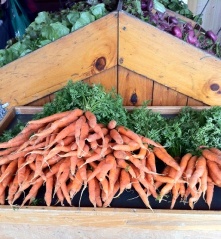
Carrots: Sweet, juicy Mokum carrots are one of the highlights of early summer on the farm. Take off the tops before storing them -- but we don't think you'll need to store them for very long.
Fennel: Fennel is another ancient vegetable that was first enjoyed by the ancient Romans. It can be used raw, slivered into salads or served as a crudite, or cooked in a variety of ways -- braised, roasted, grilled, sauteed and tossed through pasta with cream, lemon and parsley.
Scallions: easy to use anytime, raw or cooked; especially good with carrots and Napa cabbage in an Asian-inspired slaw.
'Purplette' Mini Onions: Tasty raw or cooked, the first of our fresh eating onions is here!
Summer Squash and Zucchini: the first of the season, these tender yellow squash, pattypans and green and gold zucchini were all grown at our new Gateways field in Weston, where it has so far escaped being eaten by the moose that has been seen in the neighborhood this week.
And a farmers' choice of a few other surprise items throughout the week!
Pick-your-own crops this week:
 Perennial Garden Herbs Perennial Garden Herbs - The last of the Sugar Snap and Snow Peas
- Fava Beans
- Basil
- Dill
- Cilantro
- Parsley
|
|
 |
|
Quick Links
| |
|
|
Events and Programs | |
Children's Learning Garden Programs!
Registration is now open for our well-loved summer programs! Sign up for Garden Explorers, Farmer for a Week, or perhaps you want to arrange a special one-time Farm Visit as a birthday party or for a youth group you work with.
Breakfast on the Farm w/ chef Joh Kokubo from Kitchen on Common
Sat., July 14th
Come anytime between 10am and 1pm at the Farm.
All are welcome - bring a blanket or some chairs and your friends!
$5/plate per person, $10/family |
|
Tuscan Kale & Ricotta Dumplings |
| Kindly sent in by shareholder Kathy D from Spice by Ana Sortun, this is delicious, easy-to-make, stick-to-your-ribs comfort food. The dumplings are called malfati in Italian, which means "badly made"; they're supposedly how chefs used up their leftover ravioli filling. The basic process is to mix together ricotta, egg, and flour and then add lots of cooked kale. Roll balls of this in flour and drop into boiling water. They will rise to the top within five minutes, at which point they're done. Ana Sortun serves them in a difficult-sounding chestnut soup. I serve them in a little tasty chicken stock.
Tuscan kale (also known as dinosaur kale, lacinato kale, or cavolo nero) has long, relatively flat leaves that look like black alligator skin. It has a more delicate texture than the thicker, stiffer curly kales.
1 cup ricotta cheese, strained over the sink for about 10 minutes in a fine sieve (I use part-skim cheese and very little water drains out, so the straining is unnecessary)
1 egg
1/8 tsp nutmeg
¼ cup freshly grated Parmesan cheese
1 tsp salt
¼ tsp pepper
½ cup flour plus more for dusting
4 cups chopped Tuscan kale, stems removed (or 8 c. chopped spinach)
1 Tbsp olive oil
Start boiling water in a wide pot. Place ricotta in large bowl and whisk 2 minutes until smooth and creamy. Whisk in egg. Using a wooden spoon, stir in the nutmeg, Parmesan cheese, salt, and pepper. Add the ½ cup flour and continue to stir until it is incorporated.
Chill (not for very long-I don't think this would be necessary if you cooked the kale first).
Steam the kale by sauteeing it in the one Tbsp olive oil, adding a Tbsp (or so) of water and covering the pan. Cook until wilted and tender, about 8 minutes. Drain in colander and, once it has cooled a little, squeeze handfuls of kale to get out any water. Stir the kale into the ricotta mixture. You now drop spoonfuls of the mixture onto flour and roll them into balls. The recipe says it will make eight 1' balls. I ended up with ten balls, most of which were larger than an inch across. The large ones afforded me three or more bites when I ate them. If you wanted each ball to be eaten in one bite, you should probably end up with 16 to 20 balls. Drop the balls, one at a time, into the boiling water. They will rise to the top within about five minutes. That means they're done and can be taken out with a slotted spoon. Put them in a shallow dish and cover with foil to keep them warm. erve by putting a couple of dumplings in a bowl and adding enough soup to come halfway up the dumplings.
Do you have a recipe you'd like to share? Just send it on in -- please do let us know where you found it so we can reference the source.
|
|
|
| CSA Shareholder Writes Online Book! | Laura Brass, one of our longtime shareholders, has published an online book intended to help people use and preserve their CSA shares. Laura is a great cook who has learned how to deal with the ebbs and flows of the CSA season through simple strategies for food preservation as well as easy and delicious recipes. She is excited for all of you with e-readers to check out her e-book and offer feedback -- she is considering a softcover printing in the near future. The link to the e-version of The CSA Handbook is here! Do you have a favorite recipe book that helps you use your CSA produce? Let us know!
|
Notes from the Field: July
| July. Vacation time for many people, but not so much for farmers. Long, hot days perfect for vegetable growing. Garlic harvest, tomato tying, broccoli planting, irrigating, cultivating -- there's a reason I can't remember much about July from year to year. This is nature's peak season, every square inch of ground teeming with life and the harvest beginning to pour in.
 July is not a time of the year that's commonly thought of as a time to tinker or experiment for farmers. Generally we are going full speed ahead implementing a plan we created in January, just trying to keep our heads above water and get as much done as we can before tomato harvests fill the afternoons. Last week, though, both Dan and I got projects done that we had had on our lists for -- well, for years. Dan used an old 55 gallon drum to turn our homemade transplanter into a water wheel. The water wheel adds a little water to the hole it creates for each plant as it goes into the ground, very important for fall broccoli and cabbage transplanted in the heat of summer. We are lucky enough to have overhead irrigation, which we've been using often during this hot weather to water in transplants, but overhead has its drawbacks too -- it splashes soil, which can cause plant leaf diseases (especially on crops that are in the ground for a couple of months, like those fall brassicas), and helps weeds as much as crops, since it's watering the whole bed. The water wheel gives a little starter water to the plant while keeping the rest of the field clean and dry, at least until the next thunderstorm. So why haven't we finished this project before? July. It's one of the classic "if it's not raining, my roof doesn't leak, and if it is raining, I can't fix it" conundrums. For most the rest of the year, we can time our transplanting around upcoming rain, or use existing soil moisture and cool temperatures to help establish plants; in July, when we need the water wheel, it's July. July is not a time of the year that's commonly thought of as a time to tinker or experiment for farmers. Generally we are going full speed ahead implementing a plan we created in January, just trying to keep our heads above water and get as much done as we can before tomato harvests fill the afternoons. Last week, though, both Dan and I got projects done that we had had on our lists for -- well, for years. Dan used an old 55 gallon drum to turn our homemade transplanter into a water wheel. The water wheel adds a little water to the hole it creates for each plant as it goes into the ground, very important for fall broccoli and cabbage transplanted in the heat of summer. We are lucky enough to have overhead irrigation, which we've been using often during this hot weather to water in transplants, but overhead has its drawbacks too -- it splashes soil, which can cause plant leaf diseases (especially on crops that are in the ground for a couple of months, like those fall brassicas), and helps weeds as much as crops, since it's watering the whole bed. The water wheel gives a little starter water to the plant while keeping the rest of the field clean and dry, at least until the next thunderstorm. So why haven't we finished this project before? July. It's one of the classic "if it's not raining, my roof doesn't leak, and if it is raining, I can't fix it" conundrums. For most the rest of the year, we can time our transplanting around upcoming rain, or use existing soil moisture and cool temperatures to help establish plants; in July, when we need the water wheel, it's July.
The other project we finished last week is similar -- I spent an hour reconfiguring our boom sprayer so that it could fold properly to travel between the rows of tomatoes to spray organically approved fungicides if weather conditions warrant. Those of you who remember the late blight epidemic of 2009 will know that this has been on my mind since then. So why this year? Why this July? The answer is one you all should be aware of: weed crew, and field crew.
 2012 is the third year that we've had a designated, paid weed crew who come in at eight every weekday and handweed or hoe or clip weeds until noon. We'll talk more about weeds on our farm in upcoming newsletters, but for now suffice it to say that this crew has completely changed the way we're able to spend our time on the farm. This year, Annabelle, Becca, Katy, Meghan and Maura have been diligently working since the beginning of June on each exacting planting of carrots, the daunting giant field of onions at the Lyman Estate, the quick-and-dirty work of cleaning up the cherry tomatoes as we are tying them, and every other weeding project on the farm. They've had help from some volunteer groups and from our own bookkeeper, Deb, who is keeping our flower garden meticulously clean. On our farm, the weeding is never really done. In general, though, these women are the reason that you can find sugar snap peas in the pick-your-own and that we can harvest carrots without wading through waist-high weeds (we've done it -- no fun). They are independent, unendingly cheerful, incredibly dedicated, and basically, the reason that we can work on other projects in July. We can't thank them enough. 2012 is the third year that we've had a designated, paid weed crew who come in at eight every weekday and handweed or hoe or clip weeds until noon. We'll talk more about weeds on our farm in upcoming newsletters, but for now suffice it to say that this crew has completely changed the way we're able to spend our time on the farm. This year, Annabelle, Becca, Katy, Meghan and Maura have been diligently working since the beginning of June on each exacting planting of carrots, the daunting giant field of onions at the Lyman Estate, the quick-and-dirty work of cleaning up the cherry tomatoes as we are tying them, and every other weeding project on the farm. They've had help from some volunteer groups and from our own bookkeeper, Deb, who is keeping our flower garden meticulously clean. On our farm, the weeding is never really done. In general, though, these women are the reason that you can find sugar snap peas in the pick-your-own and that we can harvest carrots without wading through waist-high weeds (we've done it -- no fun). They are independent, unendingly cheerful, incredibly dedicated, and basically, the reason that we can work on other projects in July. We can't thank them enough.
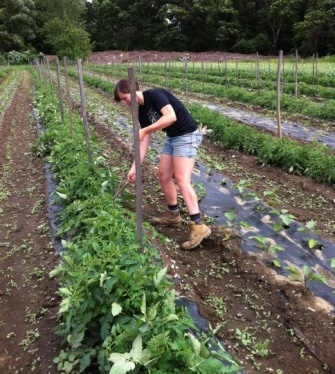 | | Alison tying tomatoes |
Our field crew, who started on the farm on June 19, have already taken our work to the next level. Their first week it was 95 degrees for three days in a row. It poured rain all day on their first Monday, and thunder and lightning chased them out of the field for an hour. They picked all day long, learning the ins and outs of harvesting crops as delicate as carrots and spinach and as tricky as beets. They pounded tomato stakes, tied tomatoes, transplanted chard, beets, lettuce, squash, and okra, direct seeded watermelons to replace a diseased crop at our Gateways field, and moved irrigation. All in their first two weeks on the farm.
 | | Dave pounding stakes in the PYO tomatoes |
When we thought about this year last winter, we knew that these first two weeks of July would be a critical point in our season. Making sure that all of our tomatoes were staked and tied at the same time as we were transplanting more than a full acre of fall brassicas, with the garlic harvest, earlier every year, likely right in the middle of all of it, has always been a time when we get behind on other tasks -- it's a juggling act that often ends with one or more balls dropped and rolling off into the weeds, never to be found again until the fall. Oops, never got a second string on the cherry tomatoes. Oops, a little late getting those beds made for the second round of broccoli. Oops, missed a planting of lettuce. It's July.
By last Friday, though, Alison, Anna, Cat and Dave had put us in a position where not only are the balls still in the air, but we seem to be developing some sense of rhythm in our juggling. Thanks to them, Sutton and Zannah were able to prepare all seventy-plus beds for the fall brassicas, disking, chiseling, adding alfalfa meal and basketing them down, so that when the plants are ready to go into the ground later this week, there is a beautifully prepared field waiting for them. We'll start our garlic harvest later today, with any luck, pulling the bulbs and bringing them in to dry down in our big greenhouse until they are properly cured and ready to use. And the weather -- well, we can't complain. Really. It's a long season -- it's not even the All-Star break yet -- and there's alot of work still to come, but right now we are joyfully rolling along in a July that feels better than it has in a while.
We farmers are fortunate enough to interact with many of you each week at the CSA pickups. We can hear your thanks and appreciation for the work we do, and see how excited you are to see carrots or tomatoes or garlic or new potatoes. The weed and field crew, because they are rarely at the pickups, don't always get the recognition they so deserve. So here it is: thank you, thank you, thank you, Alison, Annabelle, Anna, Becca, Cat, Dave, Katie, Meghan and Maura. We could not do it without you.
Enjoy the harvest,
Amanda (for the farm crew) |
|
|
|
Waltham Fields Community Farm Year-Round Staff
Claire Kozower, Executive Director
Kim Hunter, Education & Volunteer Coordinator (on maternity leave)
Fan Watkinson, Interim Education & Volunteer Coordinator
Amanda Cather, Farm Manager
Andy Scherer, Gateways Field Manager
Dan Roberts, Field Manager
Erinn Roberts, Greenhouse & Field Manager
Marla Rhodes, Development Coordinator
Deb Guttormsen, Bookkeeper & Tech Coordinator
Assistant Growers
Sutton Kiplinger, Zannah Porter
Field Crew
Alison Denn, Anna Linck, Katherine Murray, David Taberner
Weed Crew
Becca Carden, Kathryn Cole, Annabelle Ho, Meghan Seifert
Learning Garden Educators
Rebecca Byrd, Alison Dagger, Ian Howes
Work Sharers
Graphic Design, Neva Corbo-Hudak
CSA Newsletter, Susan Cassidy
Learning Garden Maintenance, Rebekah Carter
Container Garden, Dede Dussault
Perennial Garden Maintenance, Sabine Gerbatsch and Amy Hendrickson
Farm Work, Naomi Shea
CSA Distribution Coordinators: Joy Grimes, Natasha Hawke, Deepika Madan, Eileen Rojas, and Aneiage Van Bean
www.communityfarms.org 781-899-2403 |
|
|
|
|
Waltham Fields Community Farm | 240 Beaver Street | Waltham | MA | 02452
|
|
|