|
Crop Updates
 The past week of harvest was definitely an odd
one. We reached a turning point in the season -- where early
summer crops were supposed to give way to mid-summer ones -- and were
surprised to find that this did not happen. Many of the crops that
we had planned to harvest last week were not ready. Broccoli,
cauliflower and cabbage are still in the field, still small, even with
the welcome rain we had last week. Fennel, cucumbers and summer squash
are still recovering from being eaten by woodchucks. Tomatoes,
eggplant and peppers are beginning to produce, but in amounts too small
to be really satisfying. Meanwhile, our early plantings of
lettuce, kale chard, carrots and beets are petering out. This is
the challenge of multi-crop farming -- even the best laid plans are
sometimes thwarted by a combination of weather and pests. The past week of harvest was definitely an odd
one. We reached a turning point in the season -- where early
summer crops were supposed to give way to mid-summer ones -- and were
surprised to find that this did not happen. Many of the crops that
we had planned to harvest last week were not ready. Broccoli,
cauliflower and cabbage are still in the field, still small, even with
the welcome rain we had last week. Fennel, cucumbers and summer squash
are still recovering from being eaten by woodchucks. Tomatoes,
eggplant and peppers are beginning to produce, but in amounts too small
to be really satisfying. Meanwhile, our early plantings of
lettuce, kale chard, carrots and beets are petering out. This is
the challenge of multi-crop farming -- even the best laid plans are
sometimes thwarted by a combination of weather and pests.
But the essay
below, written by assistant grower Martin Lemos, should reassure you
that there are good things to come: bear with us. We
promise it will be worth it:
The season
progresses: the grasshoppers start their clacking, eggplants come on,
and a maniacal drought leaves your farmers dehydrated, nervous, and
mildly delirious. Yes, it's the height of summer and for some time now
the big summer storms seem to be skirting Waltham, and shorting the
farm on heavy rains. We mandated a daily rain-dance spearheaded by our
interns, all to no avail. So we retreated to the time-honored method of
irrigation.
Our beds of
tomatoes and peppers were watered using drip irrigation. Drip, as we
call it in the biz, consists of a line of black tape running down the
length of the beds. We turn on the drip; water fills the lines and
trickles from the small slits in the tape. This is the preferred
approach for irrigating tomatoes. Tomatoes are susceptible to blights
often brought on by moisture on their leaves. By using drip irrigation
we can water the tomato plants without spraying water directly on them.
Recent transplantings of lettuce and fall crops all received overhead
sprinkler irrigation. This involves lugging around long lines of metal
irrigation pipes, followed by a frolic in the sprinklers. From a
distance moving the pipes seems to be a daunting task, fit for hulks.
Its true folks: these farmers are beasts. Keep your distance and don't
touch their Nalgenes.
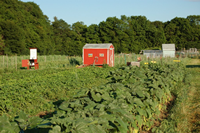 Of course the heat has its advantages. Last week we
witnessed the welcome debut of jalapeños, fiery right out of the gate.
Judging by the size of the plants, this may be an especially good year
for peppers and tomatoes, both of which enjoy the summer heat. Some of
the eggplants have begun bearing fruit and last week Anna noticed small
miniatures on the watermelon vines over at the Lyman field. Recent
plantings take off in no time. All in all, we may have one loaded
August. Of course the heat has its advantages. Last week we
witnessed the welcome debut of jalapeños, fiery right out of the gate.
Judging by the size of the plants, this may be an especially good year
for peppers and tomatoes, both of which enjoy the summer heat. Some of
the eggplants have begun bearing fruit and last week Anna noticed small
miniatures on the watermelon vines over at the Lyman field. Recent
plantings take off in no time. All in all, we may have one loaded
August.
Well the
interns must have been shaking it right with all the rain that came
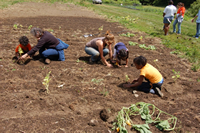
down last Wednesday. We spent the afternoon planting almost 20 beds of
broccoli, fennel, lettuce, beets and more basil. After weeks drenched
in sweat, we were soaked by the rain. The heat dizziness gave way to a
rain frenzy, sandals to galoshes. We walked away, our socks sloshing in
our shoes, happy knowing that all these plants were off to a diamond
start.
-- Martín
Lemos, Assistant Grower
|