|
Third Sunday Gatherings
|
Third Sunday Gatherings are back this season! For those of you who are new
to the farm or to Third Sunday Gatherings, they are a great opportunity to meet
fellow shareholders and learn about various topics related to our mission. Each
time, we will start with a farm-fresh potluck at five o'clock followed by a
guest speaker.
July 15th - Eat Your Greens Contest
August 19th - Putting Food By: An Introduction to
Preservation Methods
September 16th - ***TBD***Have Suggested Topics or Speakers? - send
them to Alison Horton.
October 21st - Panel on WFCF Programs: Hunger Relief, Education, Volunteers
November 18th - Harvest Potluck - Details to follow.
December 16th - Winter Solstice - Details to follow.
For more information...
|
|
|
|
|
Welcome to the 2007 Harvest Season!
|
|
 Share
pickups at the farm are: Share
pickups at the farm are:
- Tuesday,
July 17, 3-7:30 PM
- Thursday,
July 19, 3-7:30 PM
- Sunday,
July 22, 3-7:30 PM
Share
pickups in Somerville are Tuesday July 17 from 5-7 PM.
Fruit
shares
usually begin around the last week in August. Please check our website
for more information.
Bring
bags if you have them! And bring your own household compost if you
don't mind the walk to the compost piles.
|
|
Pick your own
crops this week
- Basil
- Purple, Green & Yellow
Beans
- Parsley
- Flowers
- MAYBE... a few cherry
tomatoes and/or hot peppers toward the end of the week
CSA shareholders
can visit the farm to pick your own herbs Sunday through Thursday
during daylight hours. Visit the red pick-your-own kiosk in
the fields for a list of available crops and picking supplies.
|
Crop Updates
The rain
this past week was great -- just enough to help our newly
planted fall crops begin to root in and grow. By the time
you read this, our fall planting push will be coming to
an end and we will be gearing up for our full-scale harvest
season as tomatoes, peppers and eggplant begin to form
and ripen on the plants. Thank you to everyone who did
a little rain dance for us during the dry spell.
 Dry weather, of course, has its benefits as well.
So far this season, we have not had to deal with many disease
problems, many of which are spread during wet and very hot
conditions. Many early season pests were not as bad this season,
although we definitely had our share of our usual cabbage and
onion maggots. We have seen only about 2 potato beetles this
year, which can be a terrible pest for us even though we are
not growing potatoes. We are having trouble with Mexican bean
beetles, as we usually do, and this season is particularly
bad for leaf hoppers, which generally affect potatoes, but
are choosing our beans in the potatoes' absence.
Dry weather, of course, has its benefits as well.
So far this season, we have not had to deal with many disease
problems, many of which are spread during wet and very hot
conditions. Many early season pests were not as bad this season,
although we definitely had our share of our usual cabbage and
onion maggots. We have seen only about 2 potato beetles this
year, which can be a terrible pest for us even though we are
not growing potatoes. We are having trouble with Mexican bean
beetles, as we usually do, and this season is particularly
bad for leaf hoppers, which generally affect potatoes, but
are choosing our beans in the potatoes' absence.
More cilantro
and dill are on the way, and should just about coincide
with the beginning of tomato season. Our second seeding
was overcome by weeds before it had a chance to germinate,
so we are waiting for the third one to come along.
Cukes,
squash and watermelon plants are recovering from the damage
done by the woodchucks at our Lyman Estate field. It was
looking like we would probably have a decent, if late,
crop of squash and a smaller than average crop of cucumbers,
but I noticed on Thursday afternoon that the woodchucks
are now eating the squash themselves. We'll see whether
we can outwit them again. The cucumbers and squash that
you've been eating up to now have been provided by Jenny
and Bruce Wooster at Picadilly Farm in Winchester, New
Hampshire - you'll be seeing more of Jenny and Bruce's
produce in August when they bring us potatoes.
Melons
will likely be along in mid- to late August. Many shareholders
asked us to try growing seedless watermelons - they are
easier to eat than the seeded varieties, especially for
our many families with small children. We ordered seed
from Johnny's, which cost more than twice as much as our
normal watermelon seeds. The seeds require a certain amount
of coddling in the greenhouse - they like to be no cooler
than 80 degrees and drier than the usual watermelon seeds,
otherwise they do not germinate well, as we discovered
to our chagrin when we tossed them in alongside our hardy
standby watermelons. When they did germinate, the plants
were not as vigorous as our regular watermelon plants,
but we did manage to set a few out into the field, next
to a crop of seeded watermelons, which they require for
pollination. It should be interesting to see how they produce
compared to the regular watermelons.
|
|
Notes from the Field: Feed the Bottom
Since Mark is
teaching the Children's Learning Garden programs on the farm this
summer, our house has been full of a discussion of life cycles, food
webs and garden ecology. Our son Jonah, now 4 years old, is
particularly interested in the multitude of ladybug larvae, beetles,
millipedes, rabbits, birds and flowers that inhabit the farm along with
the vegetables, and in what he can fathom of their complex web of relationships,
both harmful and beneficial. As he put it, "I'm really into this
farm stuff."
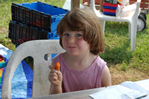 One of the things
that fascinates him the most is the idea of who eats whom in the garden
and on the farm, and what each creature gives back to the whole system.
This concept took on a whole new life when we joined a local meat CSA
this spring after years of vegetarianism. Sun, air, water and soil feed
the grass, grass feeds the cow, and the cow feeds us, though not
without a few complicated conversations. At the end of one of these,
which not coincidentally occurred during a dinner of steak tacos, Jonah
looked at us and said "if the cow feeds us, who do we feed?"
The answer that came out of my mouth surprised me (did I really just
say that?), although it probably should not have: "We feed the
compost pile and the soil. Good compost and good soil is the highest
aim of humankind." One of the things
that fascinates him the most is the idea of who eats whom in the garden
and on the farm, and what each creature gives back to the whole system.
This concept took on a whole new life when we joined a local meat CSA
this spring after years of vegetarianism. Sun, air, water and soil feed
the grass, grass feeds the cow, and the cow feeds us, though not
without a few complicated conversations. At the end of one of these,
which not coincidentally occurred during a dinner of steak tacos, Jonah
looked at us and said "if the cow feeds us, who do we feed?"
The answer that came out of my mouth surprised me (did I really just
say that?), although it probably should not have: "We feed the
compost pile and the soil. Good compost and good soil is the highest
aim of humankind."
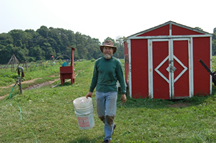 Whenever
a volunteer group comes onto the farm for a few hours of work with our
farm staff, we assemble them in a circle and begin the day by asking
each individual to think about his or her own connections to farming
and to local food. The answers we hear range from someone's first
encounter with a real peach or tomato at a farmstand in their home town
to memories of grandparents' gardens in faraway countries - but nearly
everyone has a deep, emotional connection to authentic food and the
land on which it was grown. Then we ask whether they have a sense of
what organic farming is. Almost everyone does, and almost without
exception it is a sense of what organic farming is not: it is farming
that does not use chemical pesticides, and does not use chemical
fertilizers, and tries not to degrade the land and the people in the
process of growing food. So what is it? The answer, not surprisingly,
is very similar to the one I gave Jonah about humans' place in the food
chain: organic farming is agriculture that feeds the soil so that the
soil feeds the plants. We start at the bottom and try our best to feed
the whole. Without any doubt, growing good compost and good soil are
the highest aim of the organic farmer. Whenever
a volunteer group comes onto the farm for a few hours of work with our
farm staff, we assemble them in a circle and begin the day by asking
each individual to think about his or her own connections to farming
and to local food. The answers we hear range from someone's first
encounter with a real peach or tomato at a farmstand in their home town
to memories of grandparents' gardens in faraway countries - but nearly
everyone has a deep, emotional connection to authentic food and the
land on which it was grown. Then we ask whether they have a sense of
what organic farming is. Almost everyone does, and almost without
exception it is a sense of what organic farming is not: it is farming
that does not use chemical pesticides, and does not use chemical
fertilizers, and tries not to degrade the land and the people in the
process of growing food. So what is it? The answer, not surprisingly,
is very similar to the one I gave Jonah about humans' place in the food
chain: organic farming is agriculture that feeds the soil so that the
soil feeds the plants. We start at the bottom and try our best to feed
the whole. Without any doubt, growing good compost and good soil are
the highest aim of the organic farmer.
When I really
starting thinking about this (on the tractor, where most of my most
complex thinking gets done), I realized that I was being narrow minded
about this concept in an essential way, and that is that I was
considering the soil the bottom of the food chain. This is where
organic farming gets it right. Even though the living soil is a
somewhat mysterious, often microscopic component of the work that we do
on an organic farm, much less visible than the crops or the bugs or the
birds, and even though its physical location beneath our feet tends to
make it feel like the bottom of something, it is only the bottom in
that it is a foundation, a fundament without which nothing else can be.
In all other senses, of course, the system on the farm is much more
like a cycle and a web than a linear chain, and so it is with our
participation in the food system if we choose to try to make it that
way. When you look at it this way, we feed the soil because, by doing
so, we are feeding ourselves, our friends and neighbors, and our
children.
There's more to
this story, of course. We can choose to take shortcuts to feeding
ourselves, which is where chemical fertilizers come into play. And we
can choose to take shortcuts to eating, which is where processed foods
(though Lord, how the busy mama loves them) come into play. And we can
choose to take shortcuts to feeding our neighbors, which is where
inequity in our food system comes into play. But what we are slowly,
painfully coming to realize is that the shortcuts save us time in the
short run, but they cost us in the long run: our soil, our health, the
health of our community. And this is one of the things we are trying to
do, many small farmers and the thousands of people who support them -
to unmake our perception as a society that the fundamentals can be
overlooked, to return to the knowledge that the so-called
"bottom" of our food chain is really our foundation, to the
awareness of interdependence and complexity and of the simplicity of
good, healthy food for all of us.
That's what
it's all about, all this "farm stuff." Please forgive my
soapbox, and thank you for being a part of it. Enjoy the harvest.
|
|
|
|
From all the staff at Waltham Fields Community Farm:
Meg Coward, Executive Director
Amanda Cather, Farm Manager
Andy Scherer, Assistant Farm Manager
Kate Darakjy and Martin Lemos, Assistant Growers
Josh Levin, Vincent Errico, Anna Wei, and Sara Franklin, Interns
|
|
|